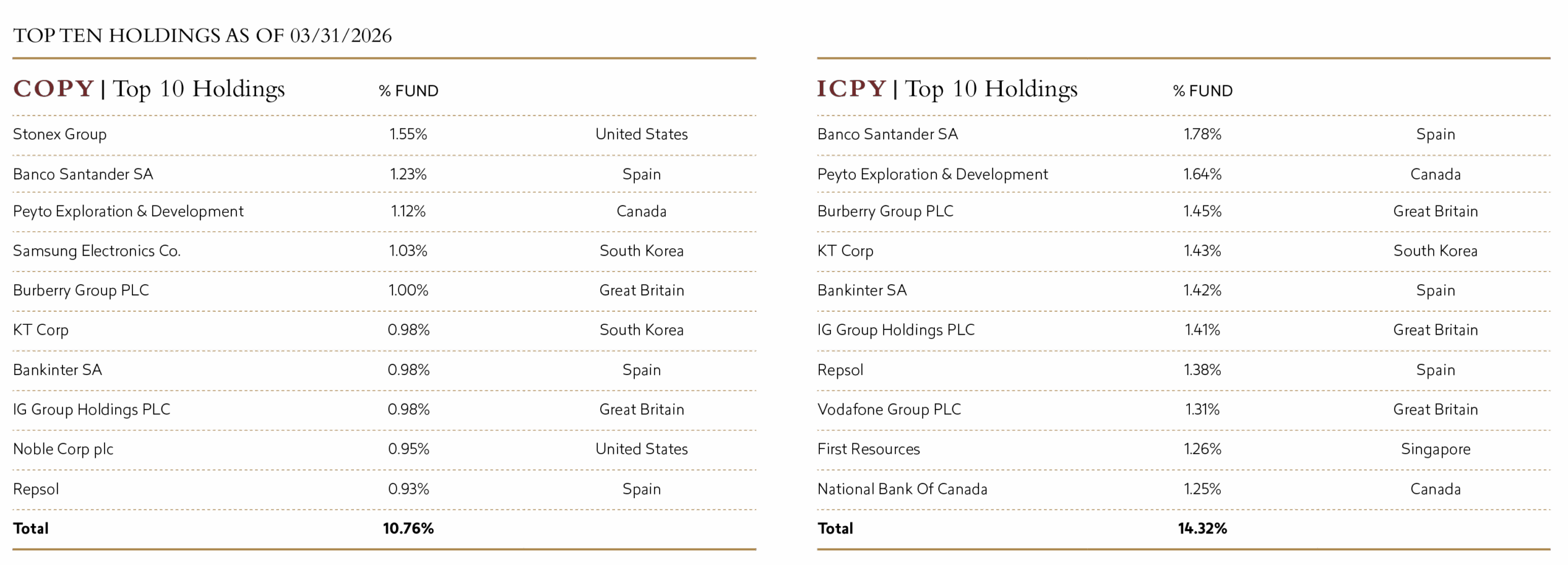
In this episode of the Inside Active podcast, host David Cohne, mutual fund and active management analyst at Bloomberg Intelligence, spoke with John Spears and Jay Hill, managing directors with Tweedy, Browne, and portfolio managers for the Insider + Value ETF (COPY) and International Insider + Value ETF (ICPY). They discuss how they define value today, why insider buying can be a powerful signal, how they separate meaningful trades from noise, and how they build portfolios designed to capture the strategy’s long-term results.
An investor should consider the investment objectives, risks, and charges and expenses of the fund carefully before investing. Click here or call 1-800-617-0004 for a copy of the Fund’s prospectus, which contains this and other information about the fund. The prospectus should be read carefully before investing.
GLOSSARY
Earnings Yield is a financial metric that expresses a company’s earnings per share (EPS) relative to its share price. It’s essentially the inverse of the price-to-earnings (P/E) ratio and is calculated by dividing the EPS by the stock price.
Dividend Yield is a measure that expresses how much income investors can expect from a stock in the form of dividends. It’s calculated by dividing a company’s annual dividend payout per share by its current stock price.
A Basis Point (or bp) is one one-hundredth of a percent (0.01%). For example, a fee moving from 1.00% to 1.10% represents a 10-basis-point increase.
SG&A (Selling, General and Administrative) expenses are the non-production operating costs required to run a business, reported on the income statement. It includes costs like marketing, rent, and executive salaries, but excludes direct production costs (COGS). Analysts use it to evaluate operational efficiency, profitability, and cost control.
R&D (Research and Development) refers to the funds a company invests in creating new products, services, or technologies, or in improving existing ones. It is a critical operating expense on the income statement that signals future growth potential but directly reduces current profitability.