
With US equity valuations already at historically elevated levels, the old adage that markets climb a wall of worry seemed particularly apt.


In our humble view, the price of money matters, and so does the price paid for a business.
Insider + Value ETFs Commentary, Q3 2026
Global equity markets continued their seemingly inexorable advance during the third quarter, shrugging off persistent inflation, geopolitical turmoil, mounting government deficits, and concerns about the cost of capital. Buoyed by solid corporate earnings, continued enthusiasm surrounding artificial intelligence, and a seemingly insatiable appetite for risk, investors appeared largely willing to look past these gathering clouds. With US equity valuations already at historically elevated levels, the old adage that markets climb a wall of worry seemed particularly apt.
Performance
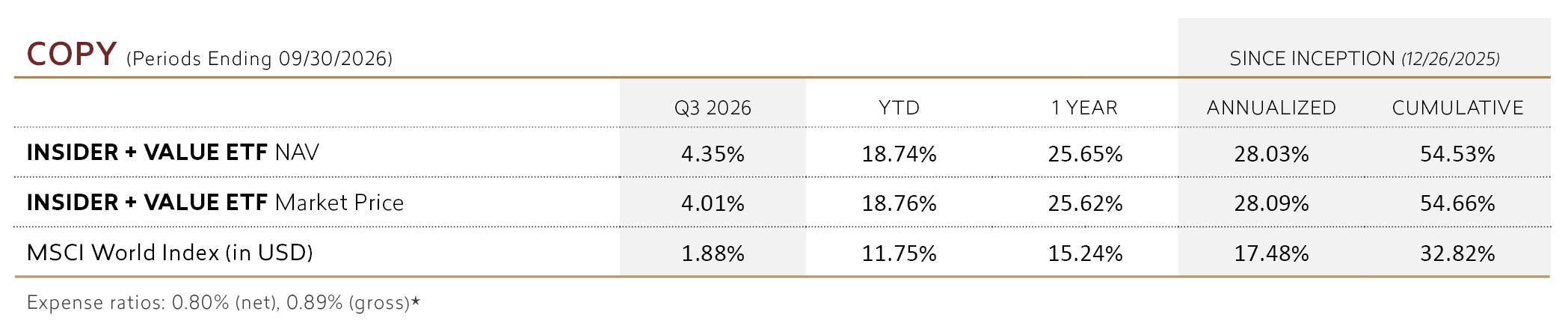
* Please note that The RBB Fund Trust (the “Trust”) and Tweedy, Browne Company LLC (the “Adviser”), as of 12/31/2025, have entered into an expense limitation agreement under which the Adviser has agreed to reimburse Fund expenses to the extent necessary so that the Fund’s total annual operating expenses (excluding interest, brokerage fees, certain insurance costs, and extraordinary and other non-routine expenses) through the period ending December 31, 2027 do not exceed 0.80% of the Fund’s average daily net assets, and also will terminate automatically upon the expiration or termination of the Fund’s advisory contract with the Adviser.
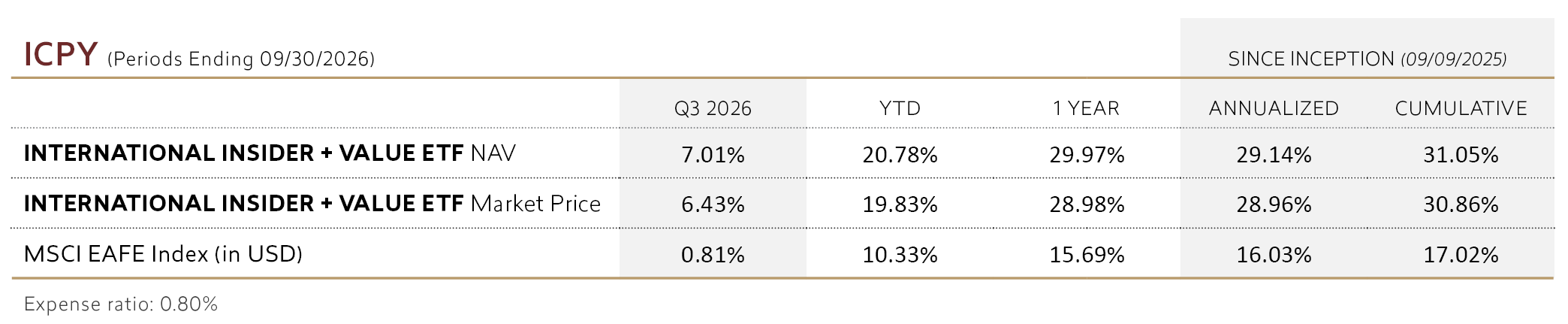
Total Returns are shown net of fund management and operating expenses. The MSCI World Index (in USD) is a free float-adjusted market capitalization weighted index that is designed to measure the equity market performance of developed markets. The MSCI EAFE Index (in USD) is an unmanaged, free float-adjusted capitalization weighted index that is designed to measure the equity market performance of developed markets, excluding the US and Canada. The MSCI EAFE Index (USD) reflects the return of the MSCI EAFE Index for a US dollar investor.
Performance data quoted represents past performance; past performance does not guarantee future results. The investment return and the value of an investment will fluctuate so that an investor’s shares, when redeemed, may be worth more or less than their original cost. The current performance of the Fund may be lower or higher than the performance quoted. For performance data that is current to the most recent month end, click here (COPY) and here (ICPY) or call 1-800-617-0004.
Shares are bought and sold at market price (not NAV) and are not individually redeemed from the Fund. Brokerage commissions will reduce returns. The market price returns are based on the official closing price of an ETF share or, if the official closing price isn’t available, the midpoint between the national best bid and national best offer (“NBBO”) as of the time the ETF calculates current NAV per share. NAVs are calculated using prices as of 4:00 p.m. Eastern time.
An encouraging development in 2026 has been broader market participation beyond the large-cap US technology companies that dominated returns in recent years. After more than a decade of extraordinary US market leadership, investors appear to be rediscovering the merits of attractively priced businesses outside the United States. We continue to find a wider assortment of opportunities in international markets, particularly among established companies with durable competitive positions, sound balance sheets, and meaningful free cash flow1. That said, a rather narrow and familiar group of large US technology companies once again led global equity returns during the quarter.
Against this mixed backdrop, both the Tweedy, Browne Insider + Value ETF (COPY) and the Tweedy, Browne International Insider + Value ETF (ICPY) made considerable financial progress during the quarter, producing net asset value returns of 4.35% and 7.01%, respectively. Both ETFs also comfortably outperformed their respective primary benchmarks during the quarter, with COPY besting the MSCI World Index (USD) by 247 basis points2 and ICPY outperforming the MSCI EAFE Index (USD) by an impressive 620 basis points. These favorable relative results extended the ETFs’ strong performance for the year-to-date period through September 30, with COPY and ICPY gaining 18.74% and 20.78%, respectively, versus advances of 11.75% and 10.33% for their respective benchmarks. While the ETFs are still quite young–COPY is less than two years old and ICPY just completed its first year— we could not be more pleased with the performance so far.

With US equity valuations already at historically elevated levels, the old adage that markets climb a wall of worry seemed particularly apt.
From a sector perspective, Energy was the largest contributor to returns across both ETFs during the quarter, reflecting strong performance from oil & gas holdings. Consumer Discretionary, Information Technology, Communication Services and Materials also contributed positively. Consumer Staples was another particularly strong contributor, especially in ICPY. On the negative side, Health Care and Utilities detracted from both ETFs, while Industrials detracted modestly in COPY.
At the industry level, oil, gas & consumable fuels was the strongest contributor across the portfolios. IT services, banks, insurance, leisure products and chemicals also contributed positively, while food products and professional services were particularly strong in ICPY. Among the principal detractors were building products, airlines, biotechnology, construction & engineering and selected retail and pharmaceutical holdings.
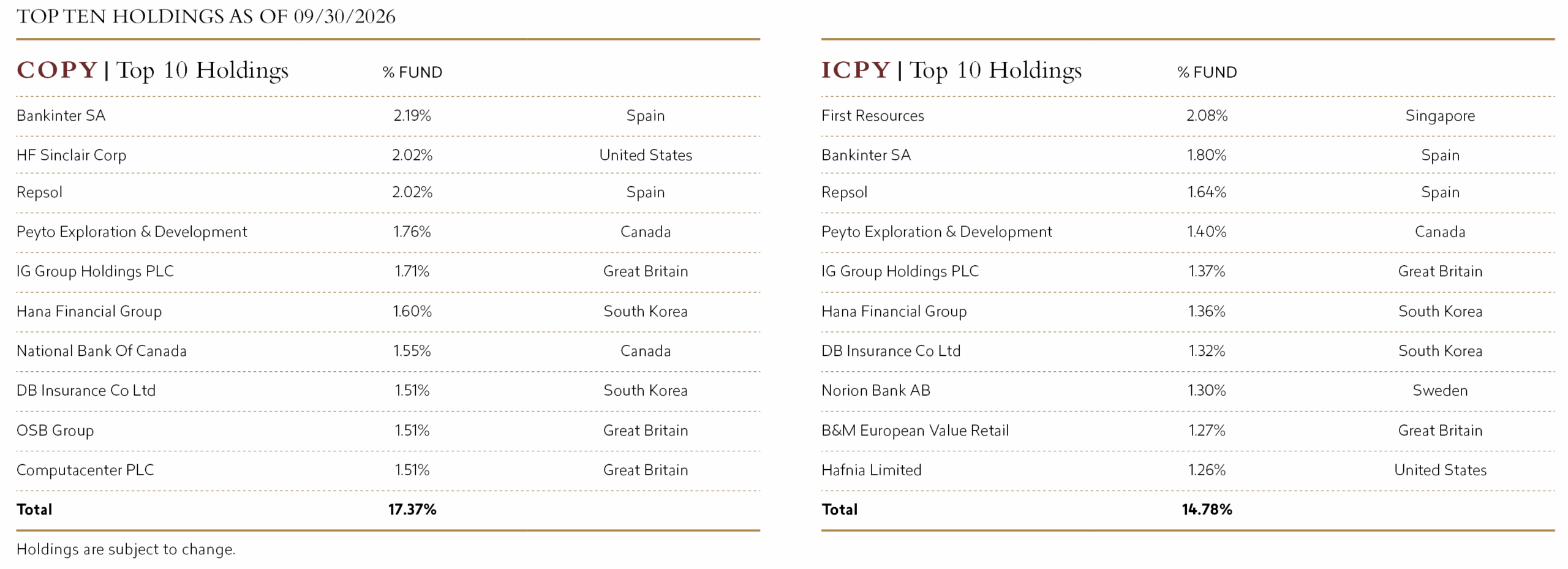
From a geographic perspective, Britain was the largest contributor across the two ETFs, with South Korea, Japan, Spain and Sweden also producing strong results. Singapore was an especially meaningful contributor in ICPY, helped by strong performance from First Resources and Hafnia. The most significant difference between the portfolios was the United States, which was the largest country detractor in COPY; ICPY, by design, had little US exposure. Germany detracted from both portfolios, while other country-level detractors were relatively modest.
Past Performance is no guarantee of future results.
At the individual security level, WPP, Repsol, Sega Sammy, DB Insurance, Computacenter and Johnson Matthey were among the notable contributors across the portfolios. First Resources and Hafnia were particularly strong contributors in ICPY, while HF Sinclair and Dorian LPG were significant contributors in COPY. Among the larger detractors common to our portfolios were IG Group, Acciona, Deutsche Lufthansa and Bouygues. COPY was also negatively impacted by several US holdings, most notably Resideo Technologies, Ionis Pharmaceuticals and Advance Auto Parts.
Currency hedging also provided a modest benefit to both ETFs during the quarter. The US dollar strengthened against a number of major currencies, including the euro, Canadian dollar and Swedish krona. Because both ETFs hedge their foreign currency exposure back to the US dollar, the portfolios were largely insulated from the negative translation effects associated with weakness in these currencies. Strength in certain foreign currencies, however, partially offset this benefit.
Despite elevated equity valuations across many areas of the global market, particularly in the US, we continue to uncover attractive opportunities where discounted valuations coincide with meaningful insider buying and shareholder-friendly capital allocation, including share repurchases.
The following examples should provide some insight into the types of opportunities we uncovered during the quarter:
We believe a sea change may be underway in global equity markets, driven in part by the rising cost of money and increasingly stretched equity valuations, particularly in the United States. If we are right, the next ten years could look considerably different from the last ten. Normalizing interest rates at higher levels may restore some of the relevance of price-sensitive investing after a prolonged period when investors were often richly rewarded for paying almost any price for anticipated growth. With longer-term US Treasury securities once again offering a meaningful alternative to equities, investors may become more discriminating about the prices they are willing to pay for future earnings and cash flows. In our humble view, the price of money matters, and so does the price paid for a business.
Several other developments give us reason for caution. Equity valuations remain historically elevated, corporate earnings expectations have become increasingly ambitious, and the extraordinary capital spending associated with artificial intelligence raises questions about the ultimate economic returns on these investments. Some of the world’s most admired technology companies appear caught in a classic prisoner’s dilemma, reluctant to moderate spending for fear of ceding an important competitive advantage to rivals. Yet it remains to be seen whether these enormous investments will generate satisfactory returns on capital, particularly as competition intensifies and historically asset-light businesses become increasingly capital intensive. Add to this the growing signs of speculative enthusiasm in equity markets, and we believe a healthy dose of caution is warranted.
None of this suggests that investors should abandon sensibly valued equities. Despite the elevated valuations and speculative enthusiasm evident in certain segments of the market, we continue to find attractive opportunities elsewhere in global equity markets, particularly outside the United States. We believe COPY and ICPY remain reasonably well-positioned, with diversified portfolios of attractively valued companies selected through a disciplined, quantitatively driven investment process that emphasizes valuation, insider buying, and opportunistic share repurchases. As the quarter’s results demonstrated, this approach can produce attractive absolute and relative returns even in a market environment characterized by considerable enthusiasm for growth-oriented equities. Should today’s exuberance eventually give way to a more discriminating, price-sensitive market environment, we would hope that our ETFs would continue to compare favorably with their benchmarks. Of course, there will be periods when our approach is less favored by the market, and we are comfortable with that trade-off. Our objective remains to compound shareholders’ capital at attractive rates over time while remaining mindful of the risk of permanent capital loss.
We sincerely appreciate your investment in our ETFs and thank you for your continued trust and confidence.
Roger R. de Bree, Andrew Ewert, Frank H. Hawrylak, Jay Hill, Thomas H. Shrager, John D. Spears, Robert Q. Wyckoff, Jr. | Investment Committee | Tweedy, Browne Company LLC
October 2026
This material must be preceded or accompanied by a prospectus. An investor should consider the investment objectives, risks, and charges and expenses of the fund carefully before investing. Click here or call 1-800-617-0004 for a copy of the Fund’s prospectus, which contains this and other information about the fund. The prospectus should be read carefully before investing.
All investing involves the risk of loss, including the loss of principal. The Fund’s buyback strategy is based, in part, on the premise that stocks of companies that engage in share buyback purchases are often anticipated to perform well because they typically are a signal that a company’s management believes its shares are undervalued. This positive signal from management may cause the value of such shares to rise. There is no certainty that management of a company undertook a buyback strategy because it believes its stock is undervalued; a company could be using buybacks to increase their price to earnings or other ratios, to alleviate excessive dilution, as a defensive measure, or to cut their own capital expenditures, thereby potentially limiting future growth.
To implement its investment strategy, the Adviser may require access to large amounts of financial data and other data supplied by various data providers. The inability to access large amounts of financial and other data from data providers could adversely affect the Adviser’s ability to use quantitative methods to select investments.
International investing may be subject to special risks, including, but not limited to, currency exchange rate volatility, political, social or economic instability, less publicly available information, less stringent investor protections, and differences in taxation, auditing and other financial practices. Investment in emerging market securities involves greater risk than that associated with investment in securities of issuers in developed foreign countries. These risks include volatile currency exchange rates, periods of high inflation, increased risk of default, greater social, economic and political uncertainty and instability, less governmental supervision and regulation of securities markets, weaker auditing and financial reporting standards, lack of liquidity in the markets, and the significantly smaller market capitalizations of emerging market issuers.
The Fund may invest in derivative instruments, including forward currency exchange contracts, which may be leveraged and may result in losses. Investments in derivative instruments may result in losses exceeding the amounts invested. The Fund’s practice of hedging exposure to foreign currencies where practicable, tends to make the Fund underperform a similar unhedged portfolio when the dollar is losing value against the local currencies in which the Fund’s investments are denominated.
Value investing involves buying stocks that are out of favor and/or viewed as undervalued by the Adviser in comparison to their peers or their prospects for growth. Securities of companies with micro-, small- and mid-size capitalizations tend to be riskier than securities of companies with large capitalizations. This is because micro-, small- and mid-cap companies typically have smaller product lines and less access to liquidity than large cap companies, and are therefore more sensitive to economic downturns.
ETFs are subject to additional risks that do not apply to conventional mutual funds, including the risks that the market price of an ETF’s shares may trade at a premium or discount to its net asset value, an active secondary trading market may not develop or be maintained, or trading may be halted by the exchange in which they trade, which may impact an ETF’s ability to sell its shares. Shares of any ETF are bought and sold at market price (not NAV) and are not individually redeemed from the ETF. Brokerage commissions will reduce returns.
Holdings are subject to change and risk.
Investors should consult with their tax professional on the impacts of investing.
DEFINITIONS
The Tweedy, Browne Insider + Value ETF and Tweedy, Browne International Insider + Value ETF are distributed by Quasar Distributors, LLC.