
Not all share repurchases are created equal. In this video, analyst Jay Hill explains why the price a company pays relative to intrinsic value is the difference between a buyback that builds wealth for shareholders and one that squanders it. And why, in the right circumstances, a buyback can be one of the most powerful capital allocation tools a company has.
[embedded video/thumbnail]
An investor should consider the investment objectives, risks, and charges and expenses of the fund carefully before investing. A prospectus, which contains this and other information about the fund may be obtained by calling 1-800-617-0004/visiting www.tweedyetfs.com. The prospectus should be read carefully before investing.
Past Performance does not guarantee future results.
All investing involves the risk of loss, including the loss of principal. The Fund’s buyback strategy is based, in part, on the premise that stocks of companies that engage in share buyback purchases are often anticipated to perform well because they typically are a signal that a company’s management believes its shares are undervalued. This positive signal from management may cause the value of such shares to rise. There is no certainty that management of a company undertook a buyback strategy because it believes its stock is undervalued; a company could be using buybacks to increase their price to earnings or other ratios, to alleviate excessive dilution, as a defensive measure, or to cut their own capital expenditures, thereby potentially limiting future growth.
To implement its investment strategy, the Adviser may require access to large amounts of financial data and other data supplied by various data providers. The inability to access large amounts of financial and other data from data providers could adversely affect the Adviser’s ability to use quantitative methods to select investments.
International investing may be subject to special risks, including, but not limited to, currency exchange rate volatility, political, social or economic instability, less publicly available information, less stringent investor protections, and differences in taxation, auditing and other financial practices. Investment in emerging market securities involves greater risk than that associated with investment in securities of issuers in developed foreign countries. These risks include volatile currency exchange rates, periods of high inflation, increased risk of default, greater social, economic and political uncertainty and instability, less governmental supervision and regulation of securities markets, weaker auditing and financial reporting standards, lack of liquidity in the markets, and the significantly smaller market capitalizations of emerging market issuers.
The Fund may invest in derivative instruments, including forward currency exchange contracts, which may be leveraged and may result in losses. Investments in derivative instruments may result in losses exceeding the amounts invested. The Fund’s practice of hedging exposure to foreign currencies where practicable, tends to make the Fund underperform a similar unhedged portfolio when the dollar is losing value against the local currencies in which the Fund’s investments are denominated.
Value investing involves buying stocks that are out of favor and/or viewed as undervalued by the Adviser in comparison to their peers or their prospects for growth. Securities of companies with micro-, small- and mid-size capitalizations tend to be riskier than securities of companies with large capitalizations. This is because micro-, small- and mid-cap companies typically have smaller product lines and less access to liquidity than large cap companies, and are therefore more sensitive to economic downturns.
ETFs are subject to additional risks that do not apply to conventional mutual funds, including the risks that the market price of an ETF’s shares may trade at a premium or discount to its net asset value, an active secondary trading market may not develop or be maintained, or trading may be halted by the exchange in which they trade, which may impact an ETF’s ability to sell its shares. Shares of any ETF are bought and sold at market price (not NAV) and are not individually redeemed from the ETF. Brokerage commissions will reduce returns.
The Tweedy, Browne ETFs are distributed by Quasar Distributors, LLC.
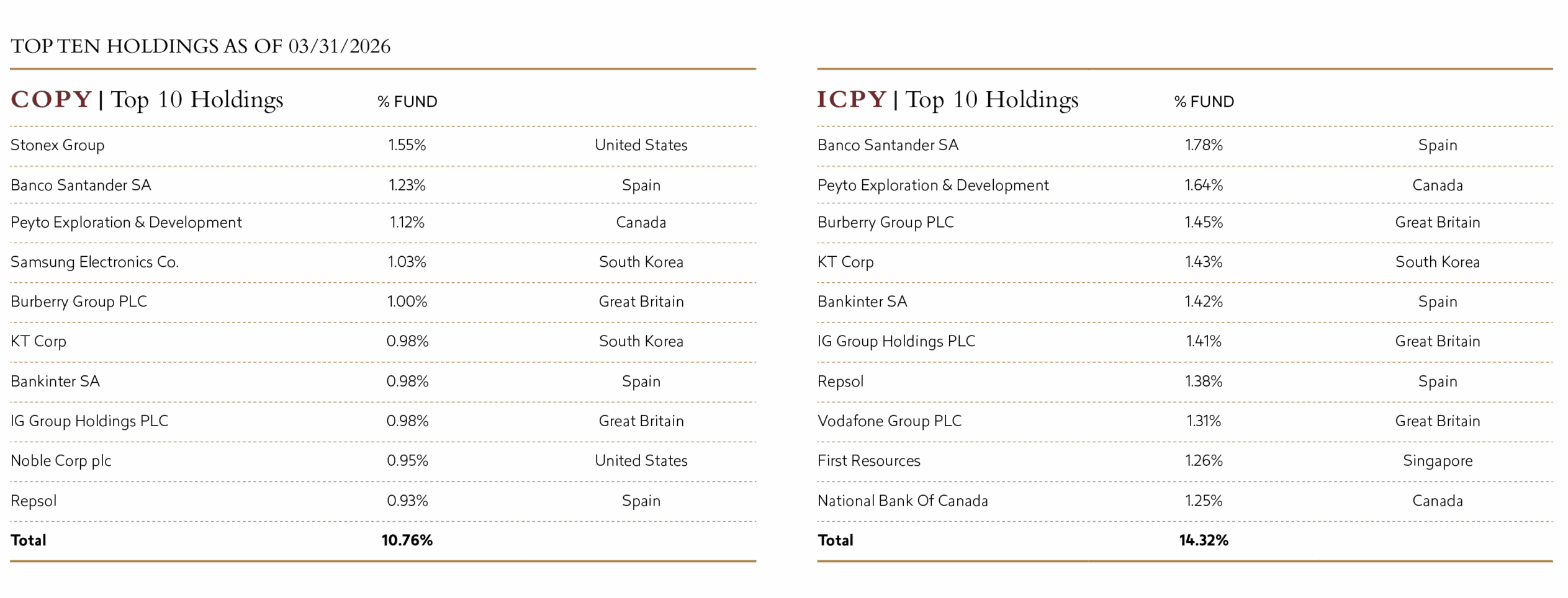
Note: Fund holdings, sector allocations and country allocations are subject to change and are not recommendations to buy or sell any security. Current and future portfolio holdings are subject to risk.
GLOSSARY
Mergers and Acquisitions (M&A) is a term used to describe businesses combining through different types of transactions.
EBITDA (Earnings Before Interest, Taxes and Amortization) is used to gauge a company’s operating profitability, adding back the non‐cash expenses of depreciation and amortization to a firm’s operating income (EBIT + depreciation + amortization expense).
